Dane County Food System Action Plan Preview
The Dane County Food System Action Plan is a community-centered initiative to create a blueprint for a stronger Dane County food system. This project used a collaborative, inclusive community engagement process to integrate the voices of stakeholders from across the food system:
- Local producers
- Food retailers
- Institutional buyers
- Community-based organizations
- Everyday eaters
The goal is to provide a shared vision for policy change, resource allocation, and infrastructure investments, as well as strengthening the relationships, networks, and leadership needed to support a healthy and thriving Dane County food system for many years to come.
How to Use This Plan
As you read this plan, you are invited to think about where you see yourself. At times, the scope of the system of the changes it needs may seem enormous, but through the collective power of the people within this system, a stronger food system that better meets all of our needs can be achieved.
This document is divided into two main sections:
The Story of Our Food System
Using the visions and themes that emerged from the community engagement process to explore the existing conditions in the Dane County food system across three primary areas: production, consumption, and infrastructure.
Planning for Action: Goals & Strategies
Expanding from the shared understanding of where things are now, the plan will introduce recommendations for the future.
What Is a Food System?
A food system includes all of the people, institutions, places, and activities that play a part in feeding us all. No single entity is responsible for the food we eat at every stage. Understanding how different foods move from where they are grown or produced to our plate and beyond, also known as supply chains, illustrates that feeding a community involves much more than just farmers and grocery stores.
Food System – The individuals, businesses, processes, and infrastructure involved in feeding people.
Supply Chain – The network of people, activities, and infrastructure needed to produce and distribute a product.
The UW–Madison Community & Regional Food Systems Project developed a framework to visualize how food systems function (Figure 1). The stages of the supply chain (right inner circle), the “enabling environment” that surrounds it (right outer circle), and the values driving it (left circle) combine to define what the food system looks like in a specific location. While supply chain sectors from production to distribution, consumption, and so on tend to be represented in most food systems, the policy, environmental, and cultural conditions of the enabling environment and the values that a community applies to food may vary from place to place.
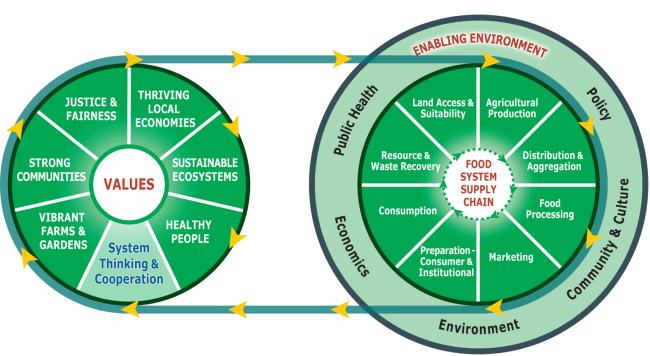
For example, food production is influenced by policies that dictate land access, impacts of climate change, and the local market price of specific products. Meanwhile, community values for low chemical inputs, fair wages to workers, and sufficient access to retailers that sell local products can also influence producers’ decisions of what to grow and sell. Food systems exist on multiple levels of society and do not simply stop at county or state boundaries. Depending on the scope, a food system may center on a very small or very large geographic area, and one food system may exist within another. For the purposes of this Plan:
- Local food systems refer to food grown, raised, or produced in Wisconsin and sold directly to consumers in Dane County with minimal intermediaries. This can be through farmers’ markets, CSAs, farm stands, or direct sales to locally owned restaurants and retailers. Dane County’s local food system is comparatively well organized and serves as a model for local food systems across the country.
- Regional food systems refer to food grown within Wisconsin and the Upper Midwest and distributed through small- and mid-scale wholesale channels to grocery stores, institutions, restaurants, and food businesses that need consistent volume. Unlike the local food system, Dane County’s regional wholesale market is less organized. The wholesale relationships that would connect mid-sized farms to grocery stores, hospitals, schools, and restaurants lack the aggregation, distribution, and coordination needed to function efficiently; this is the missing middle infrastructure referenced throughout this plan.
- National and international food systems are the large-scale supply chains through which most Dane County residents currently access the majority of their food, moving products from across the country and world into local grocery stores and restaurants regardless of where they were produced. Foods from other regions or countries that are imported into Wisconsin represent these national and international systems. Some of these markets may relate to the sale of commodity foods.
Missing Middle Infrastructure – A lack of mid-scale infrastructure for connecting regional growers and consumers. This could include storage, distribution, or retail space.
Commodity Foods – Crops grown for national and global feed, fuel, and processing markets rather than for direct human consumption in the region where they’re grown. In Dane County the primary commodity crops are corn and soybeans.
While the focus of this Action Plan is on the local and regional food systems that connect in and around Southern Wisconsin, Dane County is not independent from larger systems and shouldn’t aim to be. Control over national and international systems is largely beyond the scope of individuals in Dane County, but increasing the strength of our regional food system will naturally reduce the reliance on those larger systems.
Still, Dane County is deeply interconnected with neighboring counties, states, and beyond through consumer preferences, availability of products, and economic relationships. A significant volume of food sold in Dane County arrives weekly by truck from Milwaukee, Chicago, and other distribution hubs within the region. Products grown in our area may be exported to other places just as foods that aren’t typically produced in Southern Wisconsin may be imported. These layered food systems are the reality of a globalized food environment, and the systemic challenges we are facing here cannot be fully removed from the larger structures that the Dane County food system resides within.
Project Background
Dane County has a long history of valuing its connection to food. This has generated a highly engaged citizenry with significant support from policymakers and elected officials who understand that a healthy, productive, and vibrant food system makes our community strong and drives our economy. As Dane County continues to be one of the centers of growth both demographically and economically for the state of Wisconsin, it has become clear that a visionary approach is needed to understand the gaps and future needs of our food system.
Food system coordination is provided in multiple segments of the community. The state government, centered in Madison, provides structures for a variety of health and agricultural efforts. The University of Wisconsin generates research and deeper understanding through Extension services and faculty in multiple departments. Local food councils oversee government functions. A variety of nonprofit organizations work to address food access, business development, growing space challenges, and agricultural production. And community-led groups have emerged to provide spaces for individuals, business owners, and food service or agricultural workers to make their voices heard, leading to the need for a food system plan to align the work.
This plan builds upon efforts that have come before it, including:
- The 2011 Southern Wisconsin Food Hub Feasibility Study: Dane County commissioned this study to understand how investing in food system infrastructure could improve access to local food.
- The 2013 Healthy Food for All Children Community Plan: United Way Dane County convened the development of this plan to address child hunger from a food system lens.
- The 2018 Madison Terminal Market Report: Commissioned by the City of Madison to determine what infrastructure is needed to help the regional food system reach its potential.
- The 2023 Pandemic Food System Study: Designed to examine the role of Dane County investments in food security following the COVID-19 pandemic.
- The 2025 Healthy Food For All Food Crisis Action Plan: Developed by Healthy Food For All, FEED Kitchens, and the Northside Planning Council to outline ways to improve food access during future crises.
Each of these past efforts highlighted the need for coordination among parties to support a stronger food system. This message has resonated with local leaders who have advanced action toward this plan in several ways:
2018
The City of Madison Comprehensive Plan contained multiple food systems goals, including: Work with Dane County and other municipalities to develop a regional food systems plan.
2020-2022
The Madison Food Policy Council and Dane County Food Council began jointly exploring Food System Action Plan development in the wake of the COVID-19 pandemic.
Early 2023
REAP Food Group and other partners were awarded a USDA Regional Food System Partnership (RFSP) grant to develop a community engagement and partnership process.
Late 2023
Dane County contributed additional funding to build on the RFSP project to develop the Dane County Food System Action Plan.
2026
The Dane County Strategic Plan was released, furthering alignment with the economic and farmland preservation goals of this plan.
Project Timeline
The project consisted of three main phases.
Phase 1: Project Development & Literature Review (November 2023-January 2025)
Beginning in November 2023, the Project Team developed the following values to guide the project:
- Collaboration
- Sustainability
- Health
- Vibrance
- Resilience
- Equity
These values were used to inform process and decision-making amongst the Project Team and align understanding of the intentions behind undertaking this process.
Additionally, the following objectives were identified:
- Explore existing and innovative approaches to strengthen food systems
- Learn about the food system experiences of the people of Dane County
- Develop strategic actions for systems change
- Distribute the plan to the community
To achieve the first objective, the Project Team conducted a review of food system plans from across the United States and beyond. See Appendix A for a list of food system plans that informed this document.
The Project Team also began early planning for the later project phases that would address the remaining objectives: the community engagement process was designed, the Dane County Food System Action Plan website was created to share information about the project with the public, and initial plans for final plan distribution were outlined.
Phase 2: Community Engagement (February-August 2025)
In early 2025, the Project Team initiated a comprehensive community engagement process using a variety of strategies to collect public input. The goal was to understand the community’s existing food system needs, experiences, and challenges while engaging people to envision the changes they want to see in the future.
In addition to sessions facilitated by Project Team members, funds were made available for community members to host engagement activities within existing organizations, communities, and networks. See more information about the community engagement process.
Activities Included:
14
In-person community presentations held across the county
63
Community gatherings attended by Project Team and Community Navigators
1500
Responses to prompts at events and focus groups with key stakeholders and members of underrepresented communities
600+
Consumer survey responses
100+
Agricultural producer survey responses
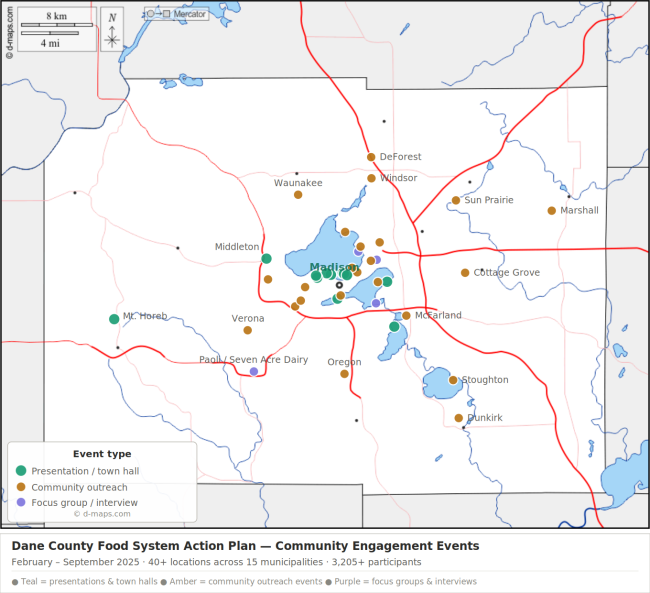
In total, feedback included input from 3,205 people across 15 different municipalities (Figure 2).
Phase 3: Data Analysis and Plan Development (August 2025-June 2026)
The Project Team, alongside partners at Second Harvest Food Bank of Southern Wisconsin and UW-Madison Extension, analyzed the qualitative and quantitative data collected from the community engagement process. To uphold the project’s values of health, resilience, and equity, an additional focused analysis of the input from individuals experiencing food insecurity was completed to ensure that the experiences, needs, and interests of people who are currently struggling within the Dane County food system were not obscured in the aggregate data.
Information gained from these analyses was used to inform development of the goals, strategies, and actions being recommended by this Plan. Draft goals and strategies were shared with key stakeholders, including the Madison Food Policy Council, Dane County Food Council, Dane County Food Collective, local government staff, and leaders of key food system nonprofit organizations. Feedback from these sessions further refined the goals and strategies.
Food System Action Plan Core Project Team