

Production
To drive through Dane County in any direction is to be surrounded by cropland, livestock, farmers’ markets, and the physical and social infrastructure of communities that are deeply connected to food production. Yet our agricultural sector is also under pressure, narrowing the path for the small- and mid-scale producers who form the backbone of the local food economy.
The food system in Southern Wisconsin exists as it does due to geological phenomena that occurred over thousands of years. As ancient glaciers slowly moved across the region, they flattened the land and brought fertile soil to what is now Dane County and eastern Wisconsin, while the areas to the west remained untouched—a rocky and rugged area known as the Driftless Region. Humans eventually settled into what is now Southern Wisconsin—first Indigenous Americans whose foodways were integrated with the surrounding environment and much later European settlers whose agricultural traditions evolved to dominate the modern landscape. While both geographic areas are suitable to the sizable dairy and livestock industries in Wisconsin, the flatter eastern part of the state is ideal for the row crops that later became monocultured commodities while the hillier Driftless Region better lent itself to crop diversity and smaller farms that require different techniques to succeed.
Dane County Production at a Glance
| Agriculture-related jobs | 14,170 |
| Total farms | 2,284 |
| Acres of farmland | 506,668 |
| % Dane County land in agriculture | 66% |
| % of production in commodity crops | 95% |
| Dane County farmland lost since 2001 | 17% |
| Dane County median age | 36.0 |
| Average farmer age | 56.7 |
Production Strengths
Today, Dane County’s agricultural sector is one of the major economic and cultural engines of our community. With over 500,000 acres of agricultural land—representing approximately 64% of the county’s total land area—and annual agricultural sales exceeding $500 million,10 Dane County ranks among the most productive agricultural counties in the United States. Part of this success is owed to the University of Wisconsin–Madison’s legacy as a land-grant institution with a long tradition of Cooperative Extension programs that have supported generations of proud farming families and cultivated a strong farming culture in the state.
Over time, Dane County has embraced innovation and now benefits from a remarkable ecosystem of direct-to-consumer and local retail sales:
- Over 20 farmers’ markets operate throughout the year across 10 different municipalities, including the Dane County Farmers’ Market, the largest producer-only farmers’ market in the United States.9
- More than a dozen farms offer community-supported agriculture (CSA) shares, serving thousands of residents annually.
- A layered marketplace of restaurants, retail outlets, on-farm sales operations, and growing institutional wholesale markets allows a diverse array of producers to find customers and build sustainable businesses.
Direct-to-consumer – A retail model where products are sold directly to the end user, bypassing retailers.
Producer-only farmers’ market – A market where all vendors grow, make, or prepare the products they sell.
Community-supported agriculture (CSA) – A model of direct consumer sales where customers purchase an up-front share in a farm’s annual production and then receive distributions of products as they are harvested throughout the season. This provides much-needed financial flexibility to farm operators.
This arrangement has led to a robust local food system featuring many successful farms and food businesses with deep ties to their customers and communities. This success has led to a strong desire among producers to grow their businesses. In our producer survey, 55% of respondents said they would like to expand their sales through new market channels. When asked what would help them do so, the most common answers were networking support (55%), increased land access (27%), and access to capital (23%).
Conservation policy has helped protect the land that makes this production possible. Dane County’s water and soils, protected by its ecological goals and its Farmland Preservation Plan, comprise a natural endowment of exceptional quality. Successes include:
- The Dane County Conservation Fund has committed up to $10 million in 2026 to support land and easement purchases.
- Agricultural Enterprise Areas, such as the Yahara Pride and Blooming Grove designations, allow farmers to enter preservation agreements in exchange for tax credits.8
- The Town of Dunn has protected nearly 4,000 acres through its Purchase of Development Rights program, making it one of the most ambitious municipal-level farmland preservation efforts in the Midwest.
- Collaborative efforts with organizations like Groundswell Conservancy have protected nearly 14,000 acres across the region.16
- The City of Madison’s inclusion of urban agriculture as an allowed use for land banking, and Dane County’s 4,000+ community garden plots across 47 acres reflect a long tradition of using public space for urban food production.
Urban agriculture – The production of food within cities and suburbs.
Land banking – A strategy to acquire land for future development.
An array of collaborators have emerged to support producers. Academic research is led by UW–Madison’s Extension faculty and institutes like the Center for Integrated Agricultural Systems and Kaufman Lab. Nonprofit support organizations like the Farley Center, Rooted WI, FairShare CSA Coalition, and REAP Food Group, provide critical land access, technical assistance, and networking support. The Midwest Vegetable Growers Network (MVEG), started by FairShare CSA Coalition and UW–Madison Extension in 2022, brings together farmers and technical assistance providers around the Midwest to support production. Advocacy organizations like the Wisconsin Farmers Union and the Farm Bureau work to improve policy and resources for the agricultural sector. All of these networks contribute to strengthening the sector’s social and organizational infrastructure.
Production Vulnerabilities
Despite these assets, the agricultural sector faces systemic pressures that threaten its future:
- Over 95% of Dane County’s agricultural acreage is devoted to corn and soybeans grown for livestock feed and fuel rather than human consumption.14 This commodity-dominated model requires intensive chemical inputs and produces concentrated excess phosphorus whose runoff degrades water quality in the Yahara Watershed and undermines the soil health that sustains long-term productivity. This challenges the core principles of sustainable agriculture.
Sustainable agriculture – An integrated system of farming practices that meet current food and production goals without sacrificing the future environment, soil quality, public health, or economic viability.
- Farm expenses surged by 32% between 2017 and 2022, squeezing farmers between rising costs and volatile global markets.36
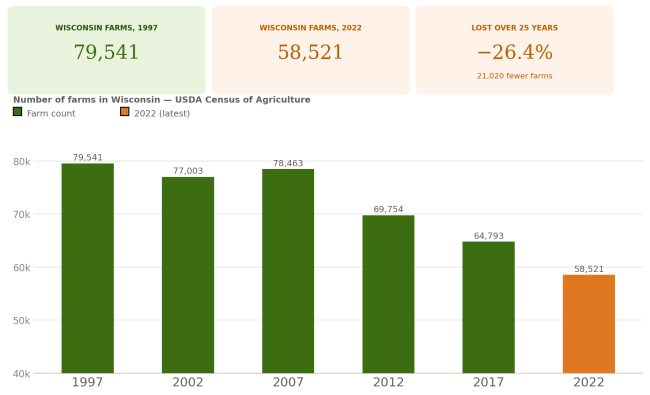
- Farm consolidation is occurring at an alarming rate. Over the past 25 years, Wisconsin has seen a 26.4% drop in total farm numbers (Figure 3). Locally, Dane County lost 76,355 acres of agricultural land, 17% of its total between 2001 and 2021, with approximately 76% of new development occurring on high-quality soils.17 As profit margins shrink and land prices rise—up tenfold from 2001 to 2024—land is increasingly being acquired by large financial entities or permanently converted to non-agricultural use.
- The average age of a Wisconsin farm producer has risen steadily to 56.7 years,17 with many farmers not having reliable healthcare or retirement funds. The lack of affordable land makes succession and transition to the next generation of farmers difficult, especially when the alternative is selling valuable Dane County land to developers or commodity producers for a potential windfall.
- Inconsistent weather patterns due to climate change and the difficulty of growing food through long Midwestern winters threaten the reliability of the local food supply.17
- Some area farmers report that when they do not have the ability or capacity to get products to consumers, they will “plow under” crops with excess yields at the end of a season while others choose to plant less than they could out of a similar calculation.
- Despite urban agricultural policies existing on paper, many remain administratively complex and underutilized in practice while short-term leases on publicly owned lands may lack the security needed for producers to invest in infrastructure or soil health.18
Agricultural Workforce
The pressures facing Dane County farms are compounded by stark racial, ethnic, and gender inequities. Over 99% of agricultural enterprises in Wisconsin are white-owned.36 Racial minority, female, and veteran farmers face disproportionate barriers to accessing land, capital, and technical assistance. Language barriers and the absence of multilingual resources further exclude many current and prospective producers.
Migrant and immigrant labor has become a critical part of the agricultural workforce at many farming operations. Undocumented Latin American immigrants perform roughly 70% of all labor on Wisconsin dairy farms, a labor force critical to the success of the state’s multi-billion-dollar dairy industry.23 This is a fragile social framework; these workers face intense geographic isolation, lack the legal right to hold driver licenses in Wisconsin, and are navigating rapidly changing immigration laws and enforcement. Housing challenges for farm laborers recently prompted Dane County to allocate an unprecedented $8 million for farmworker housing.31
Conversely, small-scale, local vegetable and meat operations face a different but equally acute workforce bottleneck. Highly diversified, direct-to-market systems rely heavily on manual tending, harvesting, and localized processing and cannot be easily mechanized. These operations are exposed to surging domestic farm labor costs that rapidly erode razor-thin profit margins.
Unfortunately, financial and social burdens carry human costs that extend beyond balance sheets. Economic instability, social isolation, and lack of access to rural healthcare have contributed to a farmer suicide rate of 43.2 per 100,000, significantly higher than the general population.13 This crisis, largely invisible in public discourse, represents profound human tragedy and a structural threat to the county’s agricultural identity.
Predicting the Future
The dominance of commodity crop production in Dane County is the product of decades of federal agricultural policy that has made growing corn and soybeans for global markets the most economically rational choice for many producers. Federal crop insurance programs, commodity price supports, and agricultural subsidies in the Farm Bill are calibrated to the scale and risk profile of commodity agriculture. Historically, this has provided a strong financial safety net for farmers, although recently even these forces have demonstrated vulnerability to mercurial geopolitical forces and international trade policy. While support for commodity producers exists, a farmer growing produce for a regional wholesale market has no equivalent backstop when a crop fails or prices fall.
Dane County cannot reverse these trends alone; improving these conditions will require state and federal policy change that centers diversified local production as the cornerstone of a healthy food system. This will lead to strategic investment in the regional infrastructure needed to make wholesale markets economically competitive and more resilient in the face of disasters.
Despite the rich assets of our community, economic volatility, loss of farmland, dominance of commodities, and social challenges for farmers show that our agricultural sector is vulnerable to disruption. By championing a holistic food system that intentionally cares for the land, animals, and people who make our food, this plan seeks to safeguard Dane County’s rich farming heritage for many years to come.