

Infrastructure
It is easy to think that food moves directly from the farm to the grocery store or directly to the dinner plate, yet there are many intermediate stages. Some products require processing; others require cold, frozen, or dry storage; and transportation is involved at every stage. These inputs are then built into the cost of the food we purchase. The infrastructure needed to bring food to consumers may be unseen by the average consumer, but it is critical for making sure our food system can operate efficiently while reducing waste and loss. If producers and consumers are the heartbeat of our food system, then the storage, processing, and distribution infrastructure are the connective tissue.
Dane County Infrastructure at a Glance
| Number of supermarkets | 98 |
| Number of convenience stores | 159 |
| Number of farmers’ markets | 29 |
Storage, Processing, and Distribution
Dane County is currently experiencing an expansion of local processing and storage infrastructure with the opening of the the Madison Public Market and the Foodshed Partnership in 2026. These spaces have potential to be a boon to small producers while creating new opportunities for business incubation and enhancing the connections between local producers, retailers, consumers, and wholesale buyers.
Shared commercial kitchen facilities like FEED Kitchens, The Hub, the Pasture & Plenty Makeshop, and the Stoughton Area Community Kitchen (STACK) serve the demand for processing space by small-scale producers, food carts, and value-added products. Bread & Butter, LLC, will be a new addition to this landscape in 2027. While entrepreneurs are able to use these facilities to build their businesses and scale up their operations, space is limited. FEED Kitchens in particular identifies year-round waitlists and 24-hour demand.
Value-added – Additions or changes made to a product that can increase its value to the end consumer and therefore merit a higher sale price. With agricultural products this can refer to combining multiple raw ingredients, preserving or adding flavor to increase shelf life, divert waste, and increase sales potential.
Investments from government sources reflect the need for more infrastructure. In 2026, the State of Wisconsin announced nearly $50 million for rural road improvements supporting agricultural transport, alongside $10 million for the Food Security Initiative. The federal Resilient Food Systems Infrastructure grant program supported middle-of-supply-chain processing and aggregation projects. Locally, the City of Madison’s Healthy Retail Access Program has invested in infrastructure enhancements to existing facilities that support a healthy retail ecosystem.
Despite these advances, there remains a critical missing middle to Dane County’s food system infrastructure. While small community kitchens and massive facilities serving multinational food corporations both exist, there is a shortage of the mid-scale, regional aggregation centers, processing facilities, cold and frozen storage, and last-mile distribution fleets that would allow local producers to reliably supply institutional buyers. The continuation and expansion of funding that builds this type of infrastructure is critical. Without this investment, importing food from distant suppliers is more cost-effective than sourcing locally, undermining the economic viability of the entire local food system.1
Last-mile distribution – The final segment of a supply chain, moving products from a storage or aggregation facility to the end user.
Food Businesses and Restaurants
The food business and restaurant landscape is an economic engine and a defining feature of Dane County’s identity. This is another form of infrastructure: the physical locations that consumers visit to purchase food in its many forms. The success of these businesses is essential for a thriving food economy.
Dane County entrepreneurs benefit from a network of support. Organizations like FEED Kitchens, the Food Finance Institute, Wisconsin Women’s Business Initiative Corporation (WWBIC), Common Wealth Development, REAP Food Group, The Urban League, UW–Madison Extension, and Urban Triage provide financial literacy, strategic planning, and professional development among other forms of skill building and technical assistance. Programs like Dane Buy Local and the Farm Fresh Atlas strengthen community support for local businesses and products. Business collaborations have led to innovative solutions for rising costs, such as shared leases between compatible businesses like Madison’s Northstreet brewery/bakery/cafe.
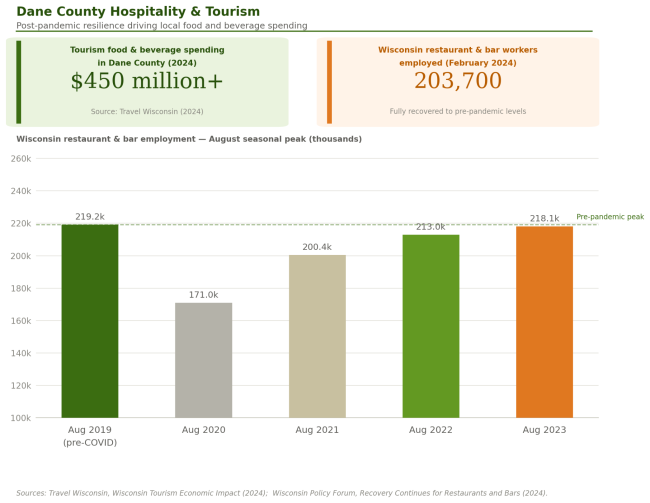
Dane County’s hospitality industry has shown remarkable post-pandemic resilience, with restaurant and bar sales reaching record highs in recent years, while employment rates have returned to pre-pandemic levels.41 Tourism generated over $450 million in food and beverage spending in Dane County in 2024 alone (Figure 4).32
The farm-to-table movement that began 50 years ago with fine-dining restaurants like L’Etoile has grown into dozens of establishments throughout the county and feature a diverse array of business models from fine dining to fast-casual businesses like Forage Kitchen, which is rapidly expanding and committed to purchasing locally. These businesses drive food preferences and channel millions of dollars annually to local farmers. Unfortunately, these businesses are also navigating the existential challenge posed by consolidation and rising costs. Food carts, disproportionately owned by racial minorities and women, face particular barriers to technical assistance, production space, and capital.19 Meanwhile, for businesses considering brick-and-mortar locations, larger developers increasingly dominate commercial real estate. This is seen most acutely in downtown Madison where retail space averages above $21 per square foot, but increasingly throughout the county where locally owned food businesses are being priced out. State Street and other high-density commercial corridors that once featured independent establishments are now seeing an influx of chains. When kitchen build-outs can require hundreds of thousands of dollars in capital investment, creative financing solutions are needed to create new business opportunities.
FOCUS: Woodman’s
Dane County’s enthusiasm for Janesville-based Woodman’s reflects the retailer’s strong connection to the community and success as a model for large-footprint supermarkets that make one-stop shopping possible for most families.
With individual locations averaging over 230,000 square feet, these are some of the largest grocery stores in the country. The three Dane County locations serve thousands of shoppers each day.
Consumer surveys indicate Woodman’s is the preferred shopping location for households across the income spectrum. While the business only operates 20 stores in Wisconsin and Northern Illinois, it has ranked 3rd best out of the 81 largest U.S. grocery chains.24
Grocery and Retail
The retail food landscape in Dane County reflects its prosperity and demand for choice. The county is home to over 81 supermarkets and grocery stores including regional chains like Festival Foods and the employee-owned Woodman’s. This is alongside big-box and club-format stores like Walmart, Target, Costco, and Sam’s Club. ALDI’s expanding footprint—six locations with a seventh under construction in Waunakee—reflects the rapid suburban growth reshaping the county. It is at stores like these that the vast majority of the county purchases the majority of their food.
Beyond the regional chains, Dane County is home to a network of locally owned and community-rooted grocery stores that offer something the mainstream retail landscape cannot: greater ties to the producers, cultures, and communities of Southern Wisconsin. Willy Street Co-op, with its three Madison-area locations, anchors this landscape as a member-owned business with a decades-long commitment to local sourcing. The Jenifer Street Market and Regent Market Co-op are beloved neighborhood institutions that emphasize local procurement. Brennan’s Market combines Wisconsin cheese, a full-service butcher, and locally curated specialty foods. Other small retailers, like the Vitruvian Farm Store and the forthcoming Grandad’s Farm Stop, offer year-round access to certified organic produce alongside over 700 products from local farmers and makers.
Culturally specific grocers, a number of which have benefited from the City of Madison’s Healthy Retail Access Program, add yet another dimension. Stores like Asian Midway Foods, Luna’s Grocery, Madison Oriental Market, Little Tibet Market, and others serve as community anchors providing culturally relevant ingredients that mainstream chains may not carry. In total, all of these retailers reflect a retail landscape of local ownership and cultural diversity.
Despite skewing toward households with higher incomes, CSAs and farmers’ markets are a unique retail opportunity that support local producers. Dane County residents support CSAs at rates comparable to much larger metropolitan areas. In 2020-2021, when COVID made it harder for people to go to the grocery store, our robust local CSA infrastructure worked to make more shares available to address the community’s increased need for local food. The Dane County Farmers’ Market remains one of the busiest public spaces in the region, and smaller farmers’ markets throughout the county are also well attended. In order to address equitable access, nutrition incentive programs like FairShare CSA Coalition’s Partner Shares and Community Action Coalition of South Central Wisconsin’s Double Dollars, seek to increase access to these pathways for people to use nutrition benefits at these retailers.
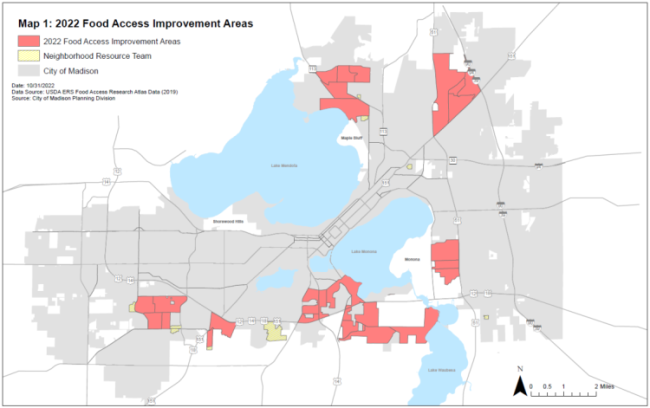
Beneath this vibrance the landscape is fragmenting in ways that leave many residents under-served. Convenience stores far outnumber full-service grocery stores, especially in areas where food insecurity is high. For many low-income residents a Kwik Trip or other gas station convenience store may be the closest and most accessible food option. The Madison Food Access Improvement Map (Figure 5) identifies areas of higher poverty where people live greater than a mile from the nearest supermarket. County-wide, over 25,500 low-income households and over 2,600 car-free households are located more than a mile from a supermarket or large grocery store, in a county where public transit coverage is limited outside of Madison.38
Rising commercial rents and well-funded national chains are displacing independent operators with local ties. In recent years, long-standing, locally and regionally owned grocers such as Festival Foods, Metcalfe’s Market, Fresh Market, and Piggly Wiggly have been acquired by larger corporate entities, reducing opportunities for highlighting local products.
In addition to the rising cost of rent, the labor market poses a complex challenge for food businesses. Retail and service staffing remains a persistent crisis despite post-pandemic wage increases. Difficult working conditions, inadequate benefits, and the perception of food service work as a “thankless” profession have fueled a workforce exodus that limits the sector’s capacity to meet consumer demand.
Emergency Food
Dane County’s hunger prevention strategies are led by a sophisticated network of emergency food providers. Second Harvest, Community Action Coalition of South Central Wisconsin, and Healthy Food for All, among others, have evolved beyond food distribution to become pillars of community food security. Each of these organizations distributes food to the 50+ food pantries throughout the county, including those serving clients county-wide like Badger Prairie Needs Network, Wayforward Resources, River Food Pantry, St. Vincent de Paul Food Pantry, and the Goodman Community Center. Other pantries have smaller service areas and target specific neighborhoods or zip codes in areas like Waunakee, Sun Prairie, Stoughton, and Mount Horeb or through mobile pantry distributions organized by Second Harvest.
In the pursuit of acquiring enough food to serve our community, these organizations practice food recovery across the entire supply chain: partnering with major corporations, local farms, restaurants, and the general public to collect donated and surplus food. Second Harvest’s Farm to Foodbank Initiative exemplifies the kind of cross-sector collaboration that simultaneously supports local agriculture and improves emergency food quality. Healthy Food for All’s Buy One For A Neighbor program at various farmers’ markets is another example of the intersection of supporting farmers, addressing food security, and using the experiences tied to buying and sharing food to build community. Additionally, organizations like the Hmong Institute, Centro Hispano, and Roots 4 Change have supported culturally relevant food distribution and wellness programs to specific segments of the population.
Pantries and food banks consistently operate beyond capacity, constrained by funding, space, and staffing. In some cases, a lack of sufficient cold and frozen storage prevents emergency food providers from accepting and distributing large quantities of fresh, perishable produce. This forces a reliance on shelf-stable and nonperishable alternatives. Other facilities are simply too small to carry the volume of produce required to meet client needs. Meanwhile, the number of staff, volunteers, and donations needed to make this safety net operate effectively requires constant effort to maintain.
The recent decline in government support has left emergency food organizations in an increasingly precarious position just as demand has shot up and inflation has increased the cost of all food. As prices go up, businesses are more vigilant to not waste as much food, and individuals with tighter budgets may be less inclined to donate food or money.